


Market Review May 2026
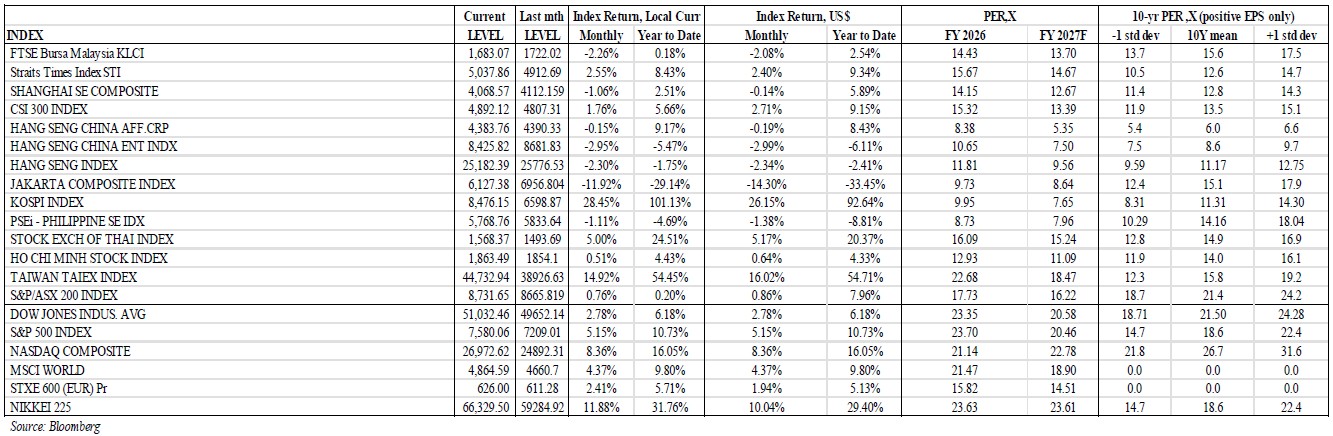 Risk assets from most major markets recovered strongly despite considerable geopolitical turbulence in the Middle East region. Latest quarter corporate earnings announcement drove investors risk appetite. Both technology and financial sector earnings were strong. The World Index gained 4.37% in May. The MSCI Far East Ex. Japan index outperformed, gaining 12.88%, driven by North Asia markets, in particular Korea and Taiwan markets which are highly leverage to the positive demand and supply dynamic of the semiconductor industry where AI capex provide strong earnings visibility. Within the Asia region, ASEAN equities lagged with a small gain of 0.23%, led by Thailand (+5.00.%) and Singapore (+2.55%) markets. Regional currencies mostly weakened against the USD. The best performing currencies were Taiwan Dollar (+0.96%) and Chinese Yuan (+0.92%), while the weaker ones were Indonesia Rupiah (-2.99%) and Korean Won (-1.80%).
US indices gained across the board on good earnings announcements amid uncertainty in geopolitical development. For the month, Dow Jones Industrial Average (DJIA), S&P 500 Index and Nasdaq Composite gained 2.78%, 5.15% and 8.36% respectively. The earnings reporting season was notably strong, with 84% of reporting companies beating consensus earnings expectations, well above the historical average of 73%, and earnings coming in 28.6% above those expectations, compared to a long-run average of 6.3%, though this has been skewed by the technology sector.
The Stoxx Europe 600 Index gained 2.41% from the prior month. The Eurozone economy lost momentum in 2Q26 as higher energy prices, geopolitical tensions, and weaker external demand weighed on economic activity. The escalation of conflict in the Middle East led to a sharp increase in oil and gas prices, raising input costs for businesses, particularly in manufacturing and transport-related sectors, while also weakening consumer confidence. Although manufacturing output received a temporary boost from precautionary inventory accumulation and front-loaded orders amid concerns over potential supply disruptions, underlying business sentiment deteriorated and companies became more cautious regarding investment and hiring plans. Domestic consumption remained the primary driver of growth, supported by resilient household spending and government investment programs. However, tighter financial conditions and sluggish export performance continued to limit broader economic expansion.
Hang Seng Index and Hang Seng China Enterprises Index declined 2.30% and 2.95% respectively. China’s economy entered 2026 on a relatively strong footing, with real GDP growth accelerating to 5.0% YoY in 1Q26 from 4.5% in 4Q25. Nominal GDP growth also improved to 4.9%, marking its fastest pace in nearly three years as deflationary pressures gradually eased. However, more recent data suggest that economic momentum weakened in 2Q26. Official Purchasing Managers’ Index (PMI) readings in May indicated that manufacturing activity remained close to the expansion threshold but continued to lose momentum amid softer external demand and rising input costs linked to geopolitical tensions in the Middle East. While the services sector showed signs of recovery, the improvement has been insufficient to offset weak consumer spending and ongoing challenges in the property market. This slowdown was also reflected in April’s macroeconomic indicators, with urban fixed asset investment returning to contraction due to slower fiscal spending (the sharpest decline in six months) while credit growth remained subdued amid continued deleveraging efforts.
South Korea’s KOSPI Index staged a remarkable rally, surging 28.45% over the past month. South Korea’s trade performance strengthened significantly in May, driven by robust demand for technology-related exports. Semiconductor exports surged 169.4% YoY to a record monthly high of US$37.16 billion, supported by rising memory chip prices and increased investment by U.S. technology firms. Computer exports also recorded exceptional growth of 290.7% amid strong demand for AI servers, while petroleum product exports increased 46.6% due to elevated oil prices. In contrast, automobile exports declined 5.9%, weighed down by supply chain disruptions in the Middle East and the impact of U.S. tariffs. By destination, exports to the United States and China rose 59.1% and 80.9%, respectively, while shipments to the Middle East fell 7.7%. Imports increased 20.8% to US$60.80 billion, marking the strongest growth since August 2022, though it was slightly below economists’ expectations. As a result, South Korea recorded a trade surplus of US$26.95 billion, up from US$23.75 billion in the previous month and the highest level on record.
Taiwan’s TWSE Index was up strongly, gaining 14.92% following positive sentiment on global technology sector. Taiwan’s economy accelerated sharply in 1Q26, with real GDP expanding 14.55% YoY, marking its fastest pace of growth in 44 years. On a seasonally adjusted basis, the economy grew 1.69% QoQ, extending its expansion streak to 12 consecutive quarters. Growth continued to be driven primarily by strong external demand linked to artificial intelligence (AI) and related infrastructure investments, which have also generated positive spillover effects across domestic consumption and capital expenditure. Private consumption strengthened, supported by increased spending on communication services, entertainment, transportation, and outbound tourism, while strong equity market performance helped boost consumer and business sentiment. Gross fixed capital formation remained robust, underpinned by sustained investments in machinery, equipment, and intellectual property. Net exports contributed 10.33 percentage points to overall GDP growth and remained the key growth driver, while contributions from private consumption (+2.16 percentage points), fixed investment (+1.69 percentage points), and government spending (+0.48 percentage points) also improved significantly. Meanwhile, the drag from inventory adjustments narrowed to -0.11 percentage points and is expected to turn positive from 2Q26 onwards following a prolonged inventory drawdown throughout 2025.
Singapore’s STI gained 2.55% in May. Singapore’s economic growth in 1Q26 was revised significantly higher, with GDP expanding 6.0% YoY and 1.0% QoQ, compared with the advance estimates of 4.6% YoY and a -0.3% QoQ. The upward revision reflected stronger-than expected performance across all major sectors of the economy. Manufacturing growth was revised up to 7.9% YoY from 5.0%, while construction expanded 11.8% YoY compared with the earlier estimate of 9.0%. The services sector also performed better than initially expected, growing 5.7% YoY versus 4.7% in the advance estimate. Within services, wholesale trade remained a key growth driver, expanding 2.3% QoQ on a seasonally adjusted basis. The sector benefited from robust demand for telecommunications equipment, computers, and electronic components, reflecting continued strength in AI-related investments and technology supply chains.
Malaysia’s KLCI declined 2.26%. Real GDP growth moderated to 5.4% YoY in 1Q26, down from 6.2% in 4Q25, although overall economic activity remained supported by strong festive spending during the Lunar New Year and Hari Raya periods, as well as government cash transfers, subsidies, and civil service wage increases. Monthly GDP data, however, pointed to a gradual loss of momentum throughout the quarter, with growth easing from 6.8% in January to 5.2% in February and 4.1% in March. The slowdown coincided with the escalation of
geopolitical tensions in the Middle East from late February, which weighed on business sentiment and economic activity.
Thailand’s SET Index gained 5.00% in May. Thailand’s economy delivered a stronger than expected performance in 1Q26, with real GDP expanding 2.8% YoY and 0.7% QoQ on a seasonally adjusted basis. Growth was supported by increased investment, stronger goods exports, higher government spending, and resilient private consumption. However, the improvement does not yet signal a fundamental shift in the economy’s growth trajectory. Beneath the headline figures, economic momentum remained uneven, as imports grew faster than exports, domestic value-added spillovers were limited, and the trade balance recorded its first deficit in 14 quarters. Exports are expected to remain the primary driver of growth in 2026, supported by strong demand for electronics, technology-related products, and automobiles, as well as front-loaded orders stemming from supply chain adjustments and rising production costs. Export growth remained robust in April, rising 23.1% YoY to US$ 31.6 billion and marking the 22nd consecutive month of expansion, while cumulative exports for January to April increased 18.9%. However, the same data also highlighted structural challenges, with imports surging 45.0% YoY in April, resulting in a US$10.0 billion trade deficit. This suggests that while export strength continues to support headline GDP growth, its benefits are not fully translating into a broad-based recovery in domestic income and economic activity.
Jakarta Composite Index continued to weaken declining 11.92% on concerns over potential downgrade by MSCI agency to frontier market status, worries about fiscal and external balances as a result of rising oil prices, and fear of greater State intervention in the commodities sector. Bank Indonesia (BI) raised its benchmark rate by 50bps to 5.25% at its May 2026 policy meeting. The policy move appears primarily aimed at supporting rupiah stability amid persistent pressure from capital outflows and external market volatility. Indonesia’s annual inflation accelerated in May, rising to 3.08% YTD from 2.42% in April. Key items driving price increases included fresh fish, rice, red chili, shallots, cooking oil, machine-rolled cigarettes, and gold jewelry. Meanwhile, core inflation remained stable at 2.59% YoY, or 0.22% MoM, indicating that underlying price pressures remained relatively contained despite elevated geopolitical uncertainties. Looking ahead, inflation is expected to average around 2.5% in 2026, although risks are tilted to the upside due to potential disruptions arising from ongoing geopolitical tensions in the Middle East and their impact on global commodity and energy prices.
The Philippines PSE Index declined 1.11%. The slowdown in economic growth reflected a combination of domestic and external challenges, including higher energy costs stemming from the conflict in the Middle East, as well as governance-related issues that weighed on public investment and consumer spending. Growth weakened across all major sectors of the economy, with agriculture contracting 0.2% YoY and construction declining 2.8%, while mining and quarrying, manufacturing, utilities, and services expanded at a slower pace of 3.8%, 0.5%, 0.7%, and 4.5%, respectively. Government expenditure emerged as the key driver of growth, accelerating to 4.8% YoY from 0.7% in 4Q25, helping to offset softer household consumption growth of 3.0% and a 2.7% contraction in investment. Economic activity was also weighed down by negative contributions from net exports (-0.2 percentage point).
Vietnam’s VN-Index gained 0.51%. Manufacturing activity showed signs of improvement in May, with the Purchasing Managers’ Index (PMI) rising to 52.8 from 50.5 in April and 49.8 a year earlier, indicating a stronger expansion in factory activity. The output index also increased sharply to 55.6, reflecting robust production conditions. However, inflationary pressures continued to build, with headline inflation edging up to 5.6% in May from 5.5% in April and 4.7% in March, reaching its highest level in six years. Despite the stronger PMI readings,
manufacturing output growth moderated to 9.0% YoY in May from 10.0% in April, bringing average growth in 2Q26 to 9.5%, compared with 11.0% in 1Q26. External trade momentum also softened, with export growth easing to 18.0% YoY from 21.0% in April, while import growth accelerated to 33.8% from 32.5%. As a result, the cumulative trade balance for January to May recorded a deficit of US$12.7 billion, compared with a US$5.0 billion surplus in the same period of 2025, marking the widest trade gap in nearly three decades.
The shift to a dovish monetary stance in the US at the start of 2026 appears now to have been upended by the war in the Middle East. After an almost 12 months of twist and turns in the US tariff saga, the market is still divided on impact of higher tariffs on macro variables such as inflation and economic activities. Meanwhile, US corporate earnings, especially in the technology sector, continue to be key pillar to hold up risk assets. US market valuations are at historical high, and the high valuation is further driven by strong capital expenditure drive for AI, which has raised questions as to whether the humongous expenditures in AI will generate the anticipated returns. The semiconductor and AI investment cycle may move into a more difficult phase as investors will start to be more discerning with regard to their return on investment. If and when the supply and demand dynamic in the semiconductor cycle should turn, on the margin, with supply capacity expanding at a time when global demand soften on lower GDP growth outlook, headwinds for the industry can be expected.
Geo-political developments as well as policy directions in the major economies, in particular US and in China, remain on our radar screen. The market is still watchful of developments in Trump’s tariffs for the key trade partners. The US tariffs scene has been marked by changes, and uncertainties remain. Meanwhile, new geo-political fissures have opened up with the recent US military raid and capture of Venezuela President, Nicolas Maduro Moros, and the repeated utterings by President Trump of his intention to bring Greenland within the US fold, militarily if necessary. Adding to these is the flare up of the military conflict between the US/Israel and Iran that has engulfed the entire Middle East and choked the supply of crude oil and LNG from the region to the world. These developments further heightened tension in global geo-politics. In the near term, the US mid- term election to be held in the later part of 2026 may change the balance of power in the US Congress, and have significant impact on US policies in the remaining years of Trump’s term. These developments will create uncertainties for investors. The duration of the Middle East war has added to uncertainty in global growth outlook as supply chain disruptions in energy sources among other things push inflation higher and change macro variables assumption.
In Asia, the focus is on the pace of China’s economic recovery which has been weaker than expected. The tariff issues with the US and continuing efforts to broaden restrictions on sales of tech equipment and services to Chinese entities can only exacerbate the economic situation in China. The Chinese property sector continues to face challenges, and any sign of stabilization and growth will have positive catalyst for China’s economy and risk assets. The Chinese government continues to bring forth measures to help the economy. The Chinese government remains constructive on policies to spur economic activities to achieve economic growth target. The various measures have boosted market sentiments. However, the longer- term effectiveness on China’s economy continues to be closely watched. It may take time for the initiatives to bear fruits. The focus will be on addressing the challenges in the property market, lifting consumer sentiments and consumption, and countering the effects of the new US tariffs.
On external trade, countries with high export dependency for growth in the Asia region including ASEAN will face significant challenges arising from the US tariff policies. The disruption in supply chain realignment may result in temporary mismatch in corporate earnings delivery against market expectation during the initial stage of tariff implementation. To-date, while ASEAN countries’ exports to the US have been impacted by the tariffs, these countries have been able to mitigate the impact on the economic growth through trade diversifications. Many of these countries have now to also contend with having to manage disruptions in energy supplies and the ensuing price escalations.
While interest rates have started to be eased, there remains headwind for risk assets, including the impact of the still high interest rate on business and economic activities, uncertainties in US policies, the historically high market valuations in the US, the geo-political tension in various parts of the world and resulting disruptions to energy supplies, as well as the still slower than expected economic growth in China. However, in the investment space we are in, we believe there is room for cautious optimism. After years of prolonged sell down, and despite the upticks in recent months, China equities remain under-owned and their favourable valuation offer potential upside, particularly following the recent rounds of significant policy change initiatives from China.
We continue to apply our strategy of focusing on identifying fundamentally healthy companies with low valuations, low leverage, high growth, robust management and a strong track record, and adherence to our investment philosophy of “Never Fully Invest at All Times” which has served us well over the years.
We thank you once again for your continued faith in us, and hope to remain good stewards in our endeavour to protect and grow your capital.