


Market Review August 2026
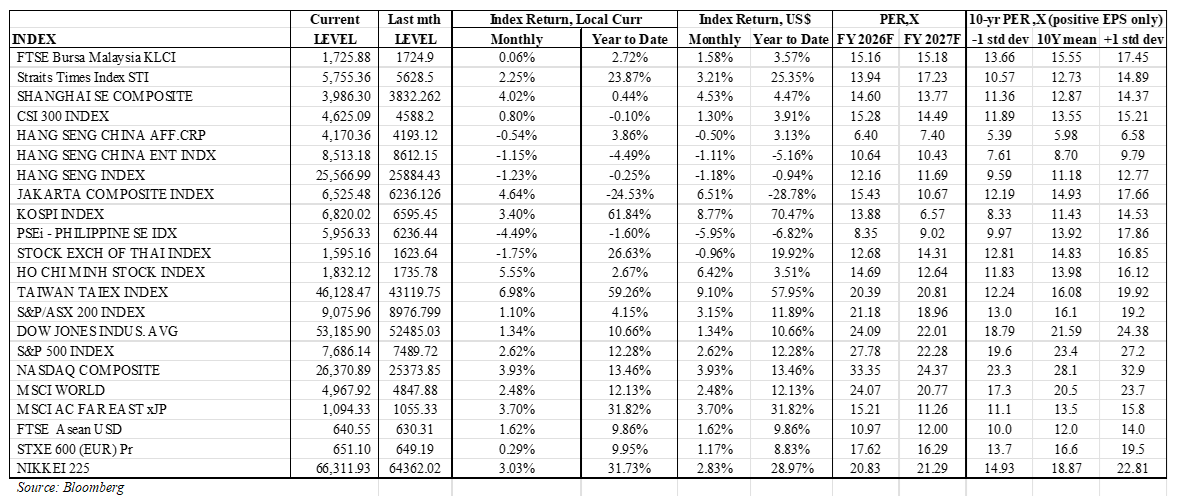 The US market and the tech heavy markets in Asia Global equity markets recovered in August 2026, although market volatility remained elevated following July’s sharp correction in AI-related stocks. Investor sentiment improved during the month, supported by resilient corporate earnings and a rebound in technology and AI-related shares. Major AI-exposed markets rebounded strongly in August, with South Korea’s KOSPI and Taiwan’s TAIEX Index recovering by 3.40% and 6.98% MoM, respectively, in US dollar terms. The month opened with considerable volatility in technology and semiconductor stocks, as mixed earnings from memory and storage renewed concerns over the sustainability of AI-related capital expenditure. The month opened with considerable volatility in technology and semiconductor stocks, as investor sentiment was weighed down by heightened concerns over valuations and the sustainability of the AI investment cycle. Sentiment pivoted decisively in the final weeks, however, after Nvidia Corporation reported a bullish sales outlook extending into fiscal year 2028, reviving confidence in the structural AI investment cycle and lifting technology benchmarks broadly. Nonetheless, Intensifying competition within the AI industry further weighed on sentiment after Chinese AI company Moonshot AI introduced its Kimi K3 model, which offers performance comparable to leading models from OpenAI and Anthropic at a substantially lower cost. Meanwhile, renewed geopolitical tensions between the United States and Iran pushed oil prices higher, reigniting concerns over inflation. At the Jackson Hole meeting on 28 August 2026, Federal Reserve Chair Kevin Warsh adopted a more hawkish stance on inflation and interest rates, reinforcing expectations that monetary policy may remain restrictive for longer. The World Index gained 2.48% in August, while the MSCI Far East Ex. Japan index gained 3.70%. Within the Asia region, ASEAN equities gained 1.62%. The best performing indices were Taiwan TAIEX Index (6.98%) and KOSPI Index (3.40%) markets. Within ASEAN, the Indonesia and Vietnam markets made good gains of +4.64% and +5.55% respectively. Regional currencies mostly strengthened against the US Dollar. The best performing currencies were Korean Won (+5.25%) and New Taiwan Dollar (+1.99%), while the weaker ones were Philippine peso (-1.81%) and Japanese Yen (-1.46%).
US equities posted broad-based gains during the month, with the Dow Jones Industrial Average (DJIA), S&P 500 and Nasdaq Composite rising 1.34%, 2.62% and 3.93%, respectively, mainly driven by a sharp recovery in large-cap technology names in the second half of the month. The month’s narrative was defined by a rotation within the technology sector, as early weakness in memory and storage stocks gave way to a broad-based rally in mega-cap technology after Microsoft Corporation and Amazon.com reported accelerating AI-related revenue growth, and Nvidia’s bullish forward guidance restored confidence in the AI investment thesis. The macroeconomic backdrop remained challenging, with continued to face challenges of inflation continuing to run above the Federal Reserve’s 2% target while economic growth softened. Headline Personal Consumption Expenditures (PCE) inflation edged up to 3.70% YoY in July from 3.67% in June, while core PCE rose to 3.34% YoY from 3.29%, indicating that underlying price pressures remained persistent. Meanwhile, 2Q2026 real GDP growth was confirmed at 1.50% on an annualized QoQ basis, well below the 2.2% market consensus, pointing to weaker domestic demand momentum. The combination of persistent inflation and slowing growth presents a challenging policy backdrop for the Federal Reserve, with limited room to ease monetary policy aggressively. Hawkish remarks from Federal Reserve Bank of Kansas City President Jeff Schmid, who indicated that monetary policy needs to remain tighter to achieve the Fed’s price stability objectives and that current policy is not sufficiently restrictive. It reinforced expectations that rate cuts are unlikely in the near term. In fact, some observers are seeing a higher probability of a rate hike. With the next FOMC meeting scheduled for 16–17 September 2026, markets are likely to closely monitor any changes in the Committee’s assessment of inflation and the outlook for monetary policy.
The STOXX Europe 600 Index gained 0.29% in August. European equities were supported by resilient corporate earnings but faced an increasingly challenging macroeconomic backdrop, as rising energy prices amid continued military exchanges between the United States and Iran in the Strait of Hormuz renewed inflation concerns and contributed to global bond yields reaching their highest levels in nearly two decades. Eurozone headline inflation rose to 3.3% YoY in August 2026, up from 2.9% in July, marking the third consecutive month of rising inflation. Core inflation, which excludes energy and food, held steady at 2.4% YoY, unchanged from July. The European Central Bank (ECB) maintained its key deposit rate at 2.25% throughout August. However, several Governing Council members signaled that a rate hike at the upcoming 10 September meeting may be warranted, reflecting growing concerns over persistent inflationary pressures. ECB Governing Council member Gediminas Šimkus stated that a rate hike in September was “very likely” and suggested that a single increase would be insufficient to bring inflation back to the ECB’s target.
The Hang Seng Index and Hang Seng China Enterprises Index declined by 1.23% and 1.15%, respectively, in August, making Hong Kong one of the weakest markets in the region during a month when most Asian benchmarks advanced. The underperformance reflected a combination of factors. China’s 2Q2026 real GDP growth remained at 4.3% YoY, unchanged from the previous quarter but still below the government’s annual growth target. Against this backdrop, Beijing announced plans to introduce additional coordinated fiscal and financial support measures in the second half of the year to bolster economic activity and growth. China’s manufacturing PMI, returned to expansion territory, rising to 51.5 in August from 49.2 in July, suggesting a recovery in factory activity. However, the non-manufacturing PMI, as measured by the China Federation of Logistics and Purchasing, remained in contraction at 49.0, unchanged from July, indicating continued weakness in the services sector. Within the Hong Kong market, Alibaba Group was a notable outperformer in the Hong Kong market during the quarter, with its shares rallying on expectations that the company can strengthen its position in the AI market. However, a large secondary share offering announced by the company in August weighed on the stock in the near term, triggering a sharp decline following the announcement. Meanwhile, mainland Chinese investors continued to increase their exposure to Hong Kong equities through the Stock Connect program, recording four consecutive days of net buying during the final week of the month.
The Korea Composite Stock Price Index advanced 3.40% in August, recovering a substantially from portion of the prior month’s sharp 16.24% decline. The month was characterized by significant intra-month volatility. following the unprecedented 17.9% single-day surge on 31 July, the KOSPI resumed its sell-off in early August, as Samsung Electronics and SK Hynix came under sharp selling pressure amid renewed concerns over the memory and storage sector. The index subsequently staged a sustained recovery, entering technical bull market territory by mid-august August as US inflation data came in broadly in line with expectations, easing concerns over an imminent Federal Reserve rate hike. Nvidia’s bullish outlook further revived investor confidence in the AI-driven semiconductor cycle, while Samsung Electronics’ announcement of a shareholder return program of up to KRW 110 trillion provided additional support to the market. On the monetary policy front, the Bank of Korea raised its benchmark policy rate by 25 basis points to 3.00% at its August meeting, marking the second consecutive hike as the central bank continued to address persistent inflationary pressures. Consumer price inflation remained at 3.10% YoY in August 2026, unchanged from July and still above the Bank of Korea’s 2.0% target. Meanwhile, semiconductor exports remained robust, with the semiconductor export index holding at 178.8 in August, broadly unchanged from July and reflecting sustained global demand for AI-related memory and logic chips. Despite the strong equity market performance during the month, hedge funds reportedly reduced their exposure to Asian technology stocks, with South Korea and Taiwan among the markets most affected in the week ended 20 August.
The Taiwan Stock Exchange Weighted Index gained 6.98% in August 2026, marking its second consecutive month of recovery. Market breadth improved significantly, with more than half of TWSE constituents trading above their 200-day moving averages by mid-August. This represented broader market participation than during South Korea’s concurrent rebound, suggesting stronger underlying conviction in Taiwan’s recovery. Meanwhile, global fund inflows into Taiwan equities reached a near four-month high in early August, reflecting renewed investor confidence in the island’s technology export cycle. Taiwan’s economic fundamentals continued to provide a strong underpinning for the market. Real GDP grew 12.93% YoY in 2Q2026, following a 15.43% expansion in 1Q2026. While growth moderated sequentially, this markedit was the third consecutive quarter of double-digit expansion, driven by sustained demand for AI-related semiconductors and advanced packaging. Meanwhile, tThe US administration’s reported draft ban on imports of certain Chinese data- centre components, including optical transceivers, may bring introduced additional geopolitical uncertainty to the technology supply chain outlook. Nevertheless, Taiwan’s strategic position as a critical node in the global semiconductor ecosystem would remain intact.
Singapore’s STI surged 2.25% in August. The market was supported by resilient domestic economic data and a significant upward revision to Singapore’s 2026 growth outlook. The Ministry of Trade and Industry raised its 2026 GDP growth forecast to 4.5%–5.5%, from 2.0%–4.0% previously, citing the sustained boost from the global artificial intelligence boom to trade and manufacturing activity, which has more than offset the drag from ongoing conflict in the Middle East. Singapore’s 2Q2026 real GDP grew 5.9% YoY and 1.4% on a seasonally adjusted QoQ basis, reflecting broad-based expansion across the economy. Manufacturing industrial production rose 6.8% YoY in July, moderating slightly from 7.2% in June, while the electronics and precision engineering sectors continued to benefit from AI-driven demand. Singapore’s position as a regional hub for semiconductor manufacturing and advanced logistics should continue to support its participation in the global technology investment cycle. Meanwhile, the Monetary Authority of Singapore’s exchange-rate-based monetary policy framework that involves managing the value of the Singapore dollar against the currencies of its major trade partners has provided some insulation against imported inflation, further supporting the economy’s resilience relative to regional peers.
Malaysia’s KLCI advanced 0.06% in August. Market sentiment remained subdued, with global fund selling of Malaysian equities reaching a near three-month high in the final week of the month. Despite the muted equity performance, Malaysia’s underlying macroeconomic fundamentals remained resilient. Real GDP expanded 6.0% YoY in 2Q2026, accelerating from 5.4% in 1Q2026. However, rising producer prices remained a concern, with the Producer Price Index (PPI) increasing 9.7% YoY in July from 9.2% in June, reflecting continued cost pressures across the manufacturing and commodities sectors. Merchandise exports reached MYR 460.5 billion in July, while imports totalled MYR 397.3 billion, resulting in a sizeable trade surplus and highlighting Malaysia’s strong position in electronics, palm oil and petroleum products. The Ringgit strengthened 1.43% against the US dollar during the month, supported by favorable external balances and broader US dollar weakness. Overall, robust export demand and improving domestic investment continued to provide a constructive macroeconomic backdrop, although near-term equity sentiment remained constrained by global risk-off episodes and volatility in the technology sector.
Thailand’s SET Index declined 1.75% in August, underperforming the broader ASEAN region despite some improvement in macroeconomic indicators. Thailand’s 2Q2026 GDP grew 1.9% YoY, although growth remained subdued relative to regional peers as higher energy prices offset the benefits of stronger investment and government stimulus. The Bank of Thailand maintained its benchmark policy rate at 1.00% for a third consecutive meeting, indicating that the current level remains appropriate to support the economic recovery. Meanwhile, Bloomberg’s latest economist survey raised its full-year 2026 GDP growth forecast for Thailand to 2.1%, from 1.8% previously. Thailand’s trade data provided a more encouraging signal, with July exports rising 21.6% YoY to USD 34.78 billion, well above the consensus of 17.8%, driven by strong demand for electronics and agricultural products. Imports increased at a faster pace of 36.7% YoY, resulting in a trade deficit of USD 3.61 billion, although this was narrower than the consensus estimate of USD 5.33 billion. Industrial production also returned to modest growth, expanding 0.46% YoY in July following a 0.8% contraction in June. However, Thailand’s strong export performance has attracted greater scrutiny from the US, with officials highlighting the widening gap between surging exports and declining domestic production as potential evidence of tariff transshipment. This poses a downside risk to Thailand’s ongoing trade negotiations with Washington. Against this backdrop, JPMorgan upgraded Thai equities to Neutral, citing improving political stability and the potential for a recovery in domestic capital expenditure.
The Jakarta Composite Index (JCI) advanced 4.64% in August 2026, ranking among the stronger-performing ASEAN markets, as investor sentiment benefited from a smooth central bank leadership transition and continued appreciation of the Indonesian Rupiah. Following the unexpected resignation of Bank Indonesia Governor Perry Warjiyo in late July, President Prabowo Subianto nominated Destry Damayanti, a senior deputy governor since 2019, as the sole candidate for the governorship. Parliament’s financial commission approved her appointment was appointed new Governor on 27 August for a full five-year term. Bank Indonesia maintained its benchmark BI-Rate at 5.75% for a second consecutive month at its August meeting, as the Rupiah’s recent appreciation reduced near-term pressure for further tightening. The central bank had previously raised rates by a cumulative 100 basis points in 2026 to support the currency and investor confidence. Meanwhile, headline CPI moderated to 3.19% YoY in August, remaining within Bank Indonesia’s target range, and providing room to maintain the current policy stance. The July trade surplus narrowed to USD 21.07 billion from USD 25.15 billion in June, reflecting higher imports as domestic demand gradually recovered. The Rupiah strengthened 1.56% against the US dollar during the month, supported by improved risk sentiment and Bank Indonesia’s continued commitment to exchange-rate stability.
The Philippine Stock Exchange Index declined 4.49% in August 2026, marking the weakest performance among the markets covered in this commentary. The sell-off decline was driven primarily by persistent foreign fund outflows, with global investors recording ten consecutive trading days of net selling in Philippine equities through late August. The MSCI quarterly index review, effective 31 August, also removed Ayala Land from the MSCI Standard Indexes, contributing to additional index-related selling pressure. Meanwhile, rising global bond yields and a broader risk-off rotation away from smaller emerging markets further weighed on investor sentiment. The macroeconomic backdrop remained mixed. Manufacturing producer price inflation eased marginally to 3.04% YoY in June 2026 from 3.11% in May, suggesting some moderation in upstream cost pressures. However, the trade deficit continued to widen, reaching an annualized level of approximately USD 58.1 billion in July, highlighting the economy’s structural reliance on imports. Persistent foreign selling, coupled with index-related outflows and a widening trade deficit, is likely to keep near-term sentiment subdued. Nevertheless, the Philippines’ strong domestic consumption base and resilient remittance inflows continue to provide fundamental support for the economy.
Vietnam’s VN-Index advanced 5.55% in August. The index fell sharply substantially by 2.1% on 14 August, marking its largest single-day decline in more than three weeks, amid concerns over limited market liquidity and investor disappointment with central bank measures. Sentiment subsequently improved in the second half of the month, supported by Vietnam’s landmark index upgrade, and encouraging economic data. The key development for Vietnamese equities was FTSE Russell’s semi-annual index review, which added more than 100 Vietnamese companies, including Vingroup JSC, Hoa Phat Group JSC, Vietnam Prosperity Joint Stock Commercial Bank and Vinhomes JSC, to its Global Equity Indexes, effective 21 September 2026. The additions are expected to give Vietnamese equities a weighting of approximately 0.49% in the FTSE Emerging Markets Index, above FTSE Russell’s earlier projection, and could attract passive inflows of around USD 3 billion. The upgrade represents an important milestone in Vietnam’s long-awaited transition from frontier to secondary emerging market status and should materially broaden the investor base over time. On the economic front, Industrial production grew 14.47% YoY in July 2026, accelerating from 12.7% in June, reflecting continued strength in electronics and manufacturing exports. Exports rose 25.0% YoY to USD 53.1 billion, while imports increased 41.4%, resulting in a trade deficit of USD 3.59 billion, the eighth consecutive monthly deficit, as manufacturers continued to expand production capacity. Consumer price inflation eased to 4.45% YoY in July from 4.69% in June, below the Bloomberg consensus estimate of 4.60%. Bloomberg’s full-year 2026 GDP growth forecast of 7.85% reflects Vietnam’s strong export-led momentum, although the persistent trade deficit and continued US scrutiny of Vietnamese manufacturing remain key risks to monitor.
The shift to a dovish monetary stance in the US at the start of 2026 had been upended by the war in the Middle East which disrupted the flow of oil exports and pushed up oil prices and brought about consequential price increases. After an almost more than 12 months of twist and turns in the US tariff saga, the market is still divided on impact of higher tariffs on macro variables such as inflation and economic activities. US market valuations are at historical high, and the high valuation is further driven by massive capital expenditure for AI. Questions have been raised as to whether the enormous AI-related capital expenditure will generate sufficient returns to justify current market expectations. News flow and developments in the AI and semiconductor space will continue to drive the markets, and tech stocks. Significant volatilities have been seen and will continue to be expected. Meanwhile, the semiconductor and AI investment cycle may be entering a more challenging phase following a broad correction across global technology markets. Investors locked in gains following the sector’s extended AI-driven rally amid concerns over stretched valuations, crowded positioning, and doubts over elevated AI-related capital expenditure will generate sufficient returns to justify current market expectations. Expectations that global interest rates may remain higher for longer further weighed on high-growth technology stocks. These developments will be keenly watched.
Geo-political developments as well as policy directions in the major economies, in particular US and in China, remain on our radar screen. The market is still watchful of developments in Trump’s tariffs for the key trade partners. The US tariffs scene has been marked by changes, the latest development being the US announcement in June of imposition of tariffs ranging from 10% to 12.5% on various countries depending on the countries’ compliance with forced labor ban. Meanwhile, the military conflict between the US/Israel and Iran has entered yet another a new phase. with the semblance of ceasefire following the signing of the US-Iran MOU seems to have all been ignored by both sides. After a period of retracement, oil prices have rallied again, but uncertainty remains as to whether this will lead to a full peace in the region. However, it has so far resulted in a substantial fall in the price of crude oil. Global stock markets have also rallied on expectation of decline in energy costs. However, uncertainty remains with instances of military strikes and counter strikes taking place. The road to conclusion of a peace agreement between the US and Iran will not be smooth, with difficulties over several issues, including Iran’s nuclear programme, the lifting of US sanctions and the Hezbollah factor.
In Asia, the focus is on the pace of China’s economic recovery which has been weaker than expected. The tariff issues with the US and continuing efforts to broaden restrictions on sales of tech equipment and services to Chinese entities can only exacerbate the economic situation in China, while presenting frictions to the US-China relationship. The Chinese property sector continues to face challenges, and any sign of stabilization and growth will have positive catalyst for China’s economy and risk assets. The Chinese government continues to bring forth measures to help the economy. The Chinese government remains constructive on policies to spur economic activities to achieve economic growth target. Priorities in terms of business sectors that would receive policy support could be expected to vary over time. The various measures are positive for market sentiments. However, the longer- term effectiveness on China’s economy continues to be closely watched. It may take time for the initiatives to bear fruit. The focus will be on addressing the challenges in the property market, lifting consumer sentiments and consumption, countering the effects of restrictive measures imposed by the US, and promoting the industries that would spearhead the country’s advances in key sectors.
On external trade, countries with high export dependency for growth in the Asia region including ASEAN will face significant challenges arising from the US tariff policies. The disruption in supply chain realignment may result in temporary mismatch in corporate earnings delivery against market expectation during the initial stage of tariff implementation. To date, while ASEAN countries’ exports to the US have been impacted by the tariffs, these countries have been able to mitigate the impact on the economic growth through trade diversifications. Many of these countries have now to also contend with having to manage disruptions in energy supplies and the ensuing price escalations.
While at least one interest rate cut is expected by the end of 2026, the outlook for risk assets continues to face several headwinds. These include the lagged effects of still-elevated interest rates on business activity and economic growth, uncertainty surrounding U.S. policy, sustainability of the historically high U.S. equity valuations, persistent geopolitical tensions, and their impact on global energy supplies, as well as slower-than-expected economic growth in China. Nevertheless, we remain cautiously optimistic about the investment opportunities within the investment space we are in. Despite the recent recovery, Chinese equities remain under-owned after several years of sustained market weakness, and current valuations continue to appear attractive. Coupled with the Chinese government’s recent policy support measures, these factors provide scope for further upside over the medium term.
We continue to apply our strategy of focusing on identifying fundamentally healthy companies with low valuations, low leverage, high growth, robust management and a strong track record, and adherence to our investment philosophy of “Never Fully Invest at All Times” which has served us well over the years.
We thank you once again for your continued faith in us and hope to remain good stewards in our endeavor to protect and grow your capital.